Learning Beyond the Classroom: The CSP Trip to Laguna
By Mara Quesada – Grade 11
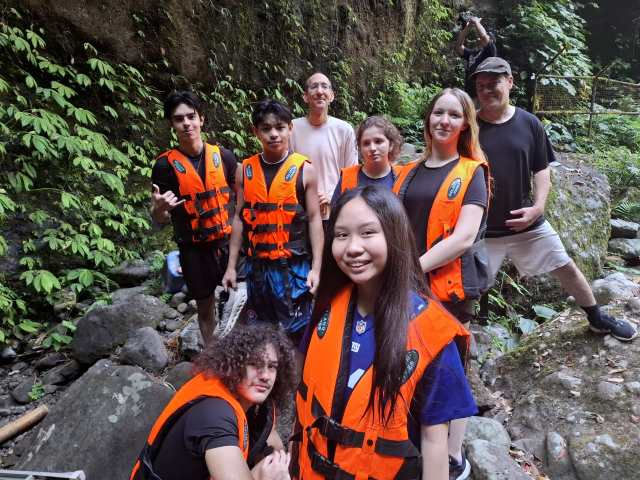
A few weeks ago, IB students took part in a CSP-CAS field trip to Panguil River Eco Park. CSP is a mandatory, interdisciplinary 10-hour team project in the IB programme that requires students from different sciences (such as Biology, Chemistry, Physics, and ESS) to work together to solve a real-world issue using scientific methods. It is connected to CAS (Creativity, Activity, and Service), which the class went on a hike as well as planting trees. These experiences encourage learning through practical, real-life experiences outside the classroom.
During the trip, the class was split into groups to complete different science-based activities and experiments over several days. The main focus was on organisms and water, where students observed the river environment and tested water conditions to better understand the ecosystem. These activities helped students apply concepts learned in science lessons to a real setting. Each group worked together to collect data, share observations, and discuss results. During those 3 days the class also had lectures made by SCPW - Society for the Conservation of the Philippines Wetland, explaining how environmental factors affect living organisms and highlighted the importance of maintaining clean and balanced ecosystems. Working in groups also improved communication and teamwork, as everyone had to cooperate to complete the tasks.
After the experimental days, each group also prepared and delivered presentations based on their findings. These presentations focused on the environment, the data collected, and the conclusions drawn from their investigations. This helped reinforce understanding and allowed students to reflect on environmental issues in a structured way.
Overall, the CSP-CAS field trip to Laguna was an important learning experience for the whole class, combining science, collaboration, and environmental awareness in a real-world context.

Comments